
The framework
Collaborative Process Governance
A governance framework for turning implicit process knowledge into shared, quantified, auditable decisions. CPG is the heart — the principles and primitives. ProcesOS is the head — the platform that thinks in processes. tech reform is the body that executes.
The problem isn't missing tools. It's missing governance.
Most organisations suffer from a fundamental disconnect: the people who design processes are not the people who run them. Critical process knowledge lives in employees' heads. Changes are decided in meetings with no record of who decided what, when, or why. The people who best understand bottlenecks are rarely consulted. And nobody can answer "What does this process actually cost per lane?" with confidence.
BPM tools address the modelling problem. GRC tools address the compliance problem. Workflow engines address the execution problem. None of them address the governance problem: how do the people who actually do the work get a structured, accountable, quantified voice in how it changes?
CPG fills that gap. It is not a tool — it is a framework. A set of principles, primitives, and a lifecycle that can be implemented in software, applied in workshops, or used as a governance standard.
Foundations
Where CPG comes from
CPG is not an invention from scratch. It synthesises three established intellectual traditions into a single operational framework.
Cybernetics
Wiener, Beer (VSM)
Governance as a feedback loop, not a linear process. The six-pillar cycle (Map → Execute → Map) is a cybernetic control loop: observe reality, model it, intervene, observe the result. Stafford Beer's Viable System Model informs the principle that governance must match the variety of the system it governs.
Commons Governance
Ostrom
Elinor Ostrom proved that communities can self-govern shared resources without top-down authority — if clear rules, defined roles, and monitoring exist. CPG applies this to organisational processes: stakeholders govern the process commons through defined roles (Responsible, Contributor, Viewer) and formal voting.
Institutional Economics
Coase, Williamson
Transaction costs and principal-agent problems are endemic in multi-stakeholder processes. CPG reduces both by making process costs visible per lane, eliminating information asymmetry between those who design processes and those who execute them.
The CPG Cycle
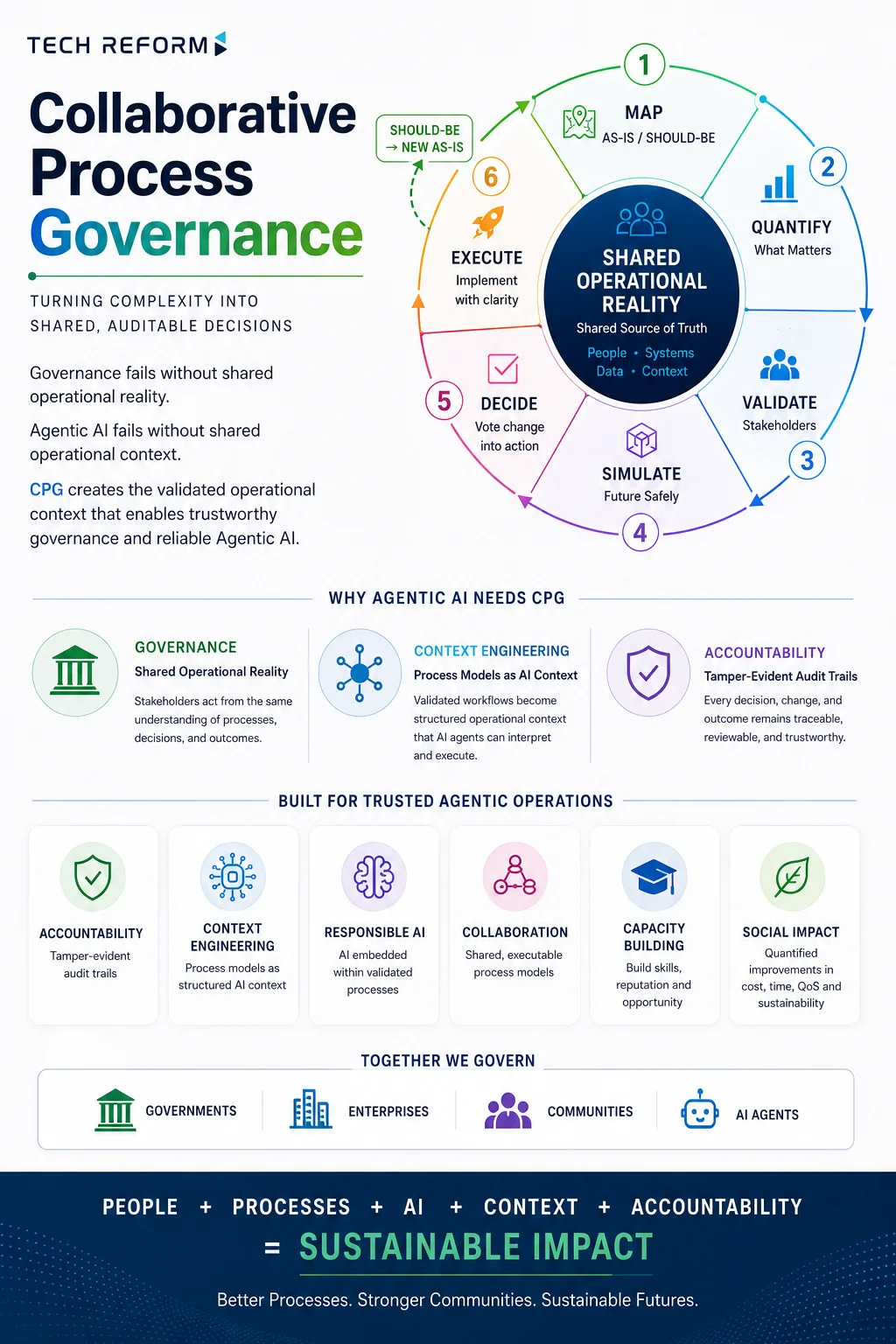
Six pillars. One cybernetic loop.
Each pillar feeds the next. The output of Execute feeds back into Map. Governance is a loop, not a line.
- 01
Map
Capture the as-is reality in BPMN 2.0. AI-assisted modelling from natural language. Every role becomes a lane, every handoff an explicit transition.
- 02
Quantify
Annotate cost, duration, frequency per task and lane. Path analysis turns the diagram into a financial model — cost/run, monthly cost, revenue, margin, ROI.
- 03
Validate
Stakeholders review lane-by-lane. Every lane needs a Responsible owner. Pre-checks enforce completeness: frequencies, costs, rates, reachable paths.
- 04
Simulate
Fork the validated process into what-if scenarios. Compare AS-IS vs. SHOULD-BE with quantified deltas — cost, time, ROI, lane-by-lane impact.
- 05
Decide
Responsible stakeholders vote on proposed changes. Configurable quorum and thresholds. Every vote recorded in an immutable decision trail.
- 06
Execute
Approved changes update the baseline. Accountability is locked. Execution is monitored against the model. Results feed back into Map.
Validation State Machine
Every process follows a strict lifecycle with formal preconditions at each transition:
Draft → Validated → Simulated → Decision Pending → Approved → Executed
→ Rejected → (back to Simulated) - Draft → Validated: All lanes have Responsible stakeholders. Consensus achieved.
- Validated → Simulated: At least one SHOULD-BE fork with quantified changes.
- Simulated → Decision Pending: Simulation submitted for stakeholder vote.
- Decision Pending → Approved: Quorum met, approval threshold reached.
- Approved → Executed: Change deployed, baseline updated, accountability locked.
Governance Primitives
The building blocks no BPM tool provides
CPG introduces six governance primitives — concepts that exist in no single tool category today. Together, they form a complete governance system for organisational processes.
- 01
Lane-Based Accountability
The BPMN swim lane is the governance unit — not the process as a whole. Each lane carries a Responsible owner, cost rates, and IT dependencies.
BPM tools treat lanes as visual decoration. CPG treats them as the smallest unit of organisational accountability.
- 02
Process-as-Financial-Model
Start events define frequency. Tasks carry duration and per-execution cost. Lanes carry hourly rates. End events define revenue. Path analysis computes cost/run, monthly cost, margin, and ROI automatically.
The BPMN diagram is the financial model. No separate BI tool, no spreadsheet reconciliation — the process calculates itself.
- 03
Non-Destructive Forking
Changes are proposed as forks of the validated baseline — independent copies that can be modified, compared, and discarded without touching the original.
Version control for processes. Traditional BPM overwrites; CPG branches. The validated baseline is never mutated directly.
- 04
Stakeholder Voting Protocol
Proposed changes go to a formal vote. Only Responsible stakeholders can vote. Quorum and approval thresholds are configurable. Every vote, comment, and justification is recorded immutably.
Neither BPM nor GRC tools have built-in democratic decision-making. CPG makes process change a governed, auditable act — not a meeting outcome.
- 05
Validation State Machine
Processes follow a strict lifecycle: Draft → Validated → Simulated → Decision Pending → Approved → Executed. Each transition has formal preconditions.
This is a governance protocol, not a workflow. Preconditions are enforced — you cannot simulate what hasn't been validated, or execute what hasn't been voted on.
- 06
Blueprint Verification Pipeline
Published processes become blueprints with three trust levels: Community (auto-scored), University Verified (AIFOD partner validation), Nationally Certified (integrated into national infrastructure).
Processes as reusable, verifiable artefacts — with a trust escalation path from grassroots to institutional adoption.
Architecture
Three layers. Each solves a governance problem.
CPG's architecture is not a tech stack — it is a governance stack. Each layer addresses a specific governance question.
-
Process Layer
BPMN 2.0What happens and what does it cost?
The modelling standard. ISO-compliant, interoperable, no vendor lock-in. Extended with business metrics — cost, duration, frequency, revenue — that make the diagram self-calculating.
-
Identity Layer
SSI / W3C DIDsWho decides and why are they authorised?
Self-Sovereign Identity with Verifiable Credentials. Governance roles (Responsible, Contributor, Viewer) are cryptographically bound to stakeholders. No central authority issues permissions.
-
Trust Layer
DLT (Cardano)Is the decision tamper-proof?
On-chain voting and credential verification. Decisions are publicly verifiable and immutable. The audit trail exists outside any single system.
Positioning
CPG sits at the intersection — and belongs to none
CPG crosses five market categories. Each addresses one dimension of the process problem. CPG addresses them all — from a governance-first perspective.
| Category | What it does | What CPG adds |
|---|---|---|
| BPM Suites | Process modelling | Governance, voting, per-lane quantification, financial model from the diagram |
| Workflow Engines | Process execution | CPG governs the decision about the process, not the execution itself |
| Process Mining | As-is analysis from system logs | CPG starts from stakeholder knowledge, not log data — and adds governance on top |
| GRC Tools | Compliance documentation | Compliance as a byproduct of governance, not a separate documentation effort |
| Governance Models | Organisational design | Process-level (not org-level) governance — and quantified with financial data |
Governance Model
Three roles. Clear authority boundaries.
Every lane in a CPG-governed process has stakeholders with defined governance roles. Authority is explicit: who can propose, who can vote, who can observe.
Responsible
Accountable for the lane. Can propose changes, vote on decisions, and comment. Owns the outcome. At least one per lane — mandatory for validation.
Contributor
Works on tasks within the lane. Can propose changes and participate in discussions. No voting rights — influence without authority.
Viewer
Observes the process and can comment. Provides transparency without decision authority. Essential for cross-functional visibility.
Compliance
Compliance as a byproduct, not a burden
Because CPG produces mapped processes, quantified metrics, stakeholder assignments, decision trails, and auditable state transitions as part of normal governance operations, compliance reporting becomes a data query — not a documentation project.
ESG
IT carbon categories, stakeholder inclusion, decision trails, workload distribution visibility.
SDG
Process activities tagged with SDG alignment. Impact measured through quantified outcomes.
FAIR
BPMN 2.0 ensures interoperability. Structured, searchable, exportable, reusable as blueprints.
NIS2
IT dependencies per task via CMDB. Security processes mapped with clear accountability.
GDPR / DSGVO
Data processing flows traced per step. Controller/processor roles mapped to lanes.
EU AI Act
AI integration points documented. Human oversight mapped to Responsible stakeholders.
Adoption
Five maturity levels
CPG adoption is incremental. Each level builds on the previous and delivers standalone value.
- 01
Documented
Processes mapped in BPMN 2.0. Basic documentation exists.
- 02
Quantified
All tasks annotated with cost, duration, frequency. Process economics visible.
- 03
Governed
Stakeholders assigned to lanes. Validation workflows active. Decision trails recorded.
- 04
Simulated
AS-IS vs. SHOULD-BE comparisons standard. Changes simulated before implementation.
- 05
Cybernetic
Full governance loop active. Execution feeds back into mapping. Continuous improvement is data-driven and stakeholder-governed.
From framework to practice
The heart, the head, and the body.
CPG is the heart — the principles, primitives, and governance lifecycle that define how process decisions should be made. A methodology that can be adopted independently of any tool. Published, open, and designed for institutional adoption.
ProcesOS is the head — the platform that thinks in processes. BPMN modelling with built-in quantification, stakeholder validation, simulation, voting, and audit trails. It operationalises CPG in software.
tech reform is the body — the executing force. We work according to CPG, use ProcesOS as the operational backbone, and deploy it into client infrastructure — from workshop facilitation through to sovereign deployment.
Want to adopt CPG in your organisation?
We run structured workshops that take you from undocumented processes to governed, quantified operations — in a single day.