
The platform
ProcesOS
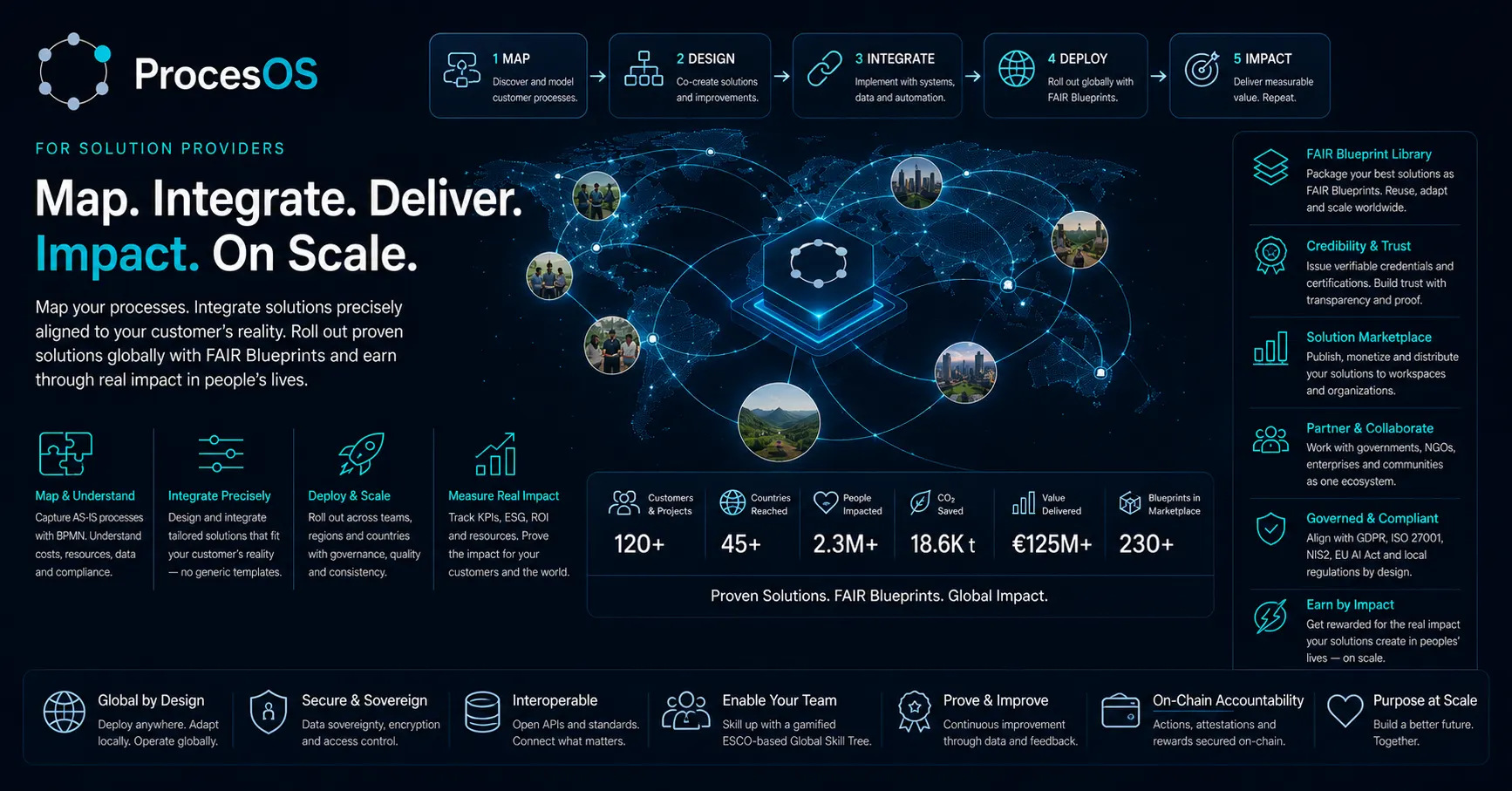
If CPG is the heart — the governance principles — then ProcesOS is the head: the platform that thinks in processes and in the capabilities beneath them, quantifies both, and makes every decision auditable. tech reform is the body that deploys it into your infrastructure.
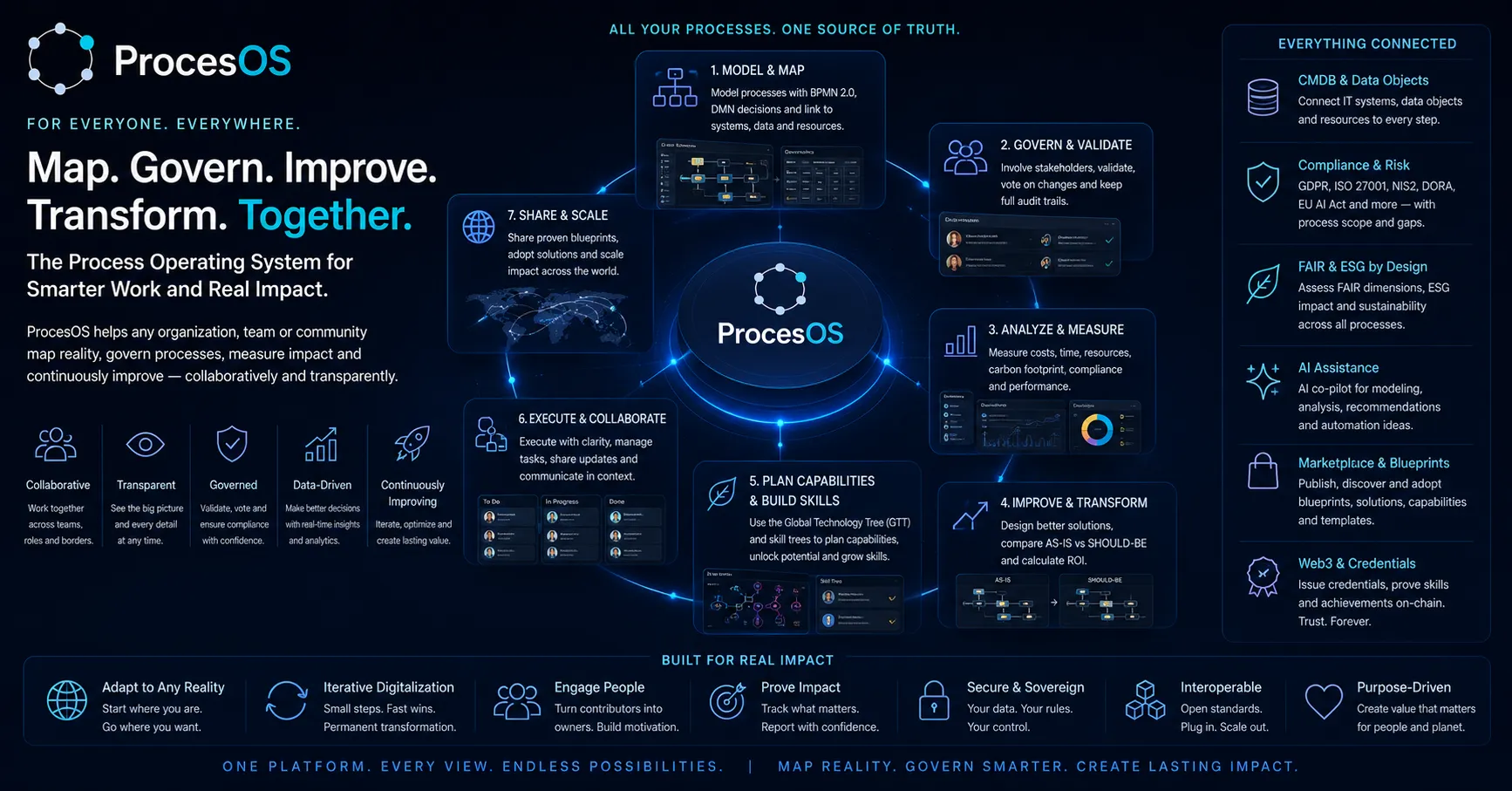
The problem isn't missing tools. It's missing governance.
The CPG framework defines how process governance should work — six pillars, three architectural layers, and governance primitives that no BPM tool provides. ProcesOS is the software that makes CPG operational.
Every stakeholder gets a defined role, every decision gets an auditable trail, and every process gets a financial model — automatically, from the BPMN diagram itself. tech reform works by CPG, uses ProcesOS as the operational backbone, and deploys it into your infrastructure.
ProcesOS is not a process execution engine. It is the governance layer for collaborative process decisions across organisational boundaries — BPMN 2.0 as the shared language, stakeholder voting as the decision mechanism, on-chain anchoring for immutable audit trails. Execution engines run processes. ProcesOS governs who decides what runs, how, and why.
AI Governance Runtime
Human oversight, made measurable.
The UN's Independent International Scientific Panel on AI put it plainly in its 2026 report: human oversight of AI "is not operationalized as a measurable requirement" — and the unit of evaluation must be the deployed system, including tools, environment, and users, not the model alone. That gap is exactly where ProcesOS operates.
The missing layer is not AI access. It is AI operationalisation: AI agents acting inside governed processes — with defined roles, approval gates, audit trails, and measurable outcomes. ProcesOS makes human oversight executable, auditable, and quantifiable.
- 01
Human-in-the-loop by default
Wizzy, the built-in AI assistant (Anthropic, OpenAI, or Mistral — bring your own key), reads and drafts freely. But every write to a diagram requires an explicit human approval: apply, adjust, or decline.
- 02
The L1–L7 maturity ladder
Every process sits on a unified maturity ladder — Descriptive, Analytical, Governed, Compliant, Sustainable, Integrated, Cybernetic — computed from real workspace state, not self-assessment.
- 03
A governance lifecycle, not a checkbox
Stakeholder validation → ISMS compliance review → promote-to-AS-IS vote with configurable quorum. Validated AS-IS versions are immutable; change flows through voting.
- 04
Sovereignty, scored
Every IT system in the CMDB gets an EU Sovereignty Score (0–100, grade A–E), including US CLOUD Act exposure and FAIR maturity — measured by a scanner, not claimed in a slide.
For every sector
One platform. Every sector.
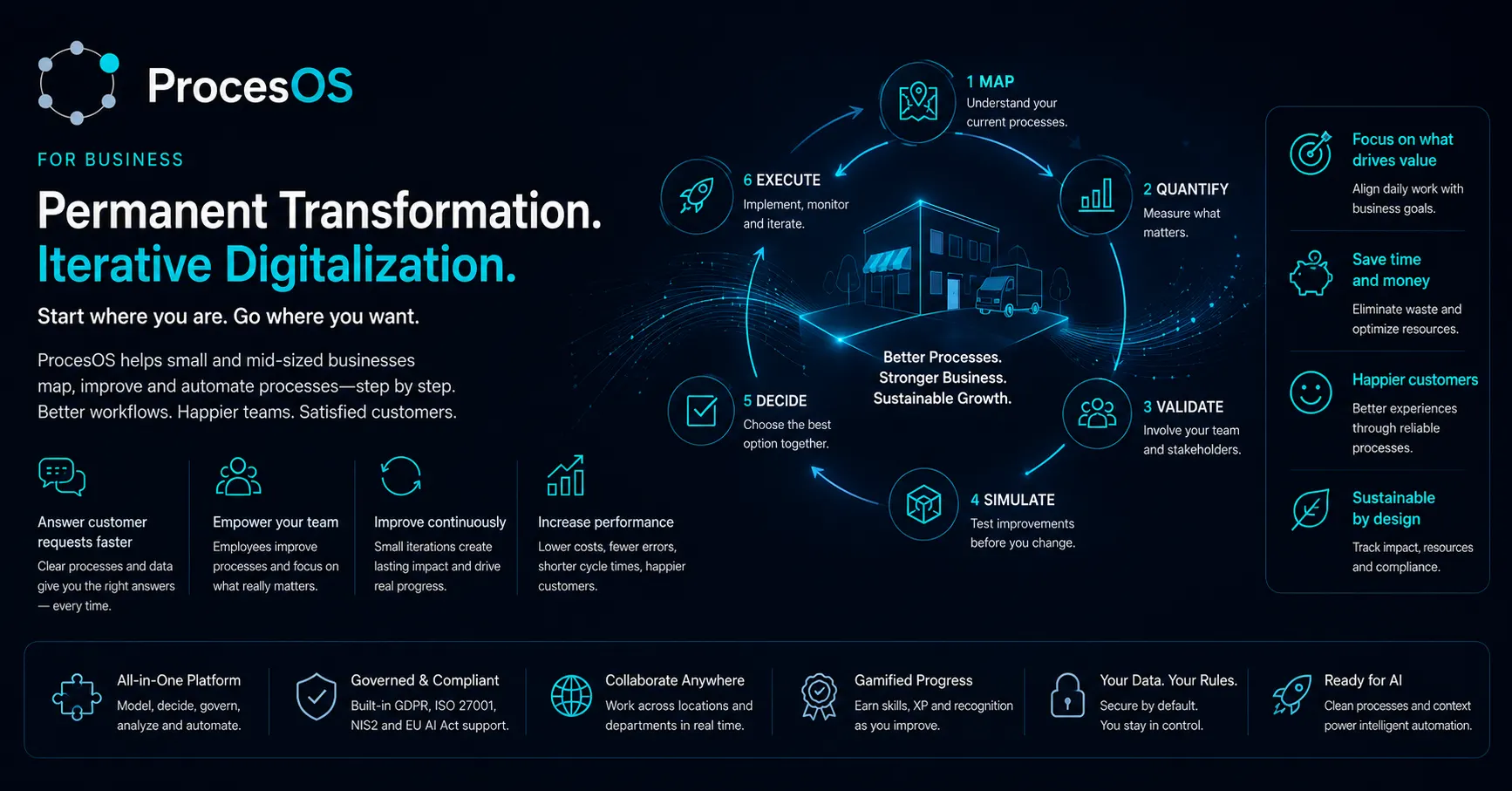
The same governance core, framed for who is in the room — from a single business to a national government.
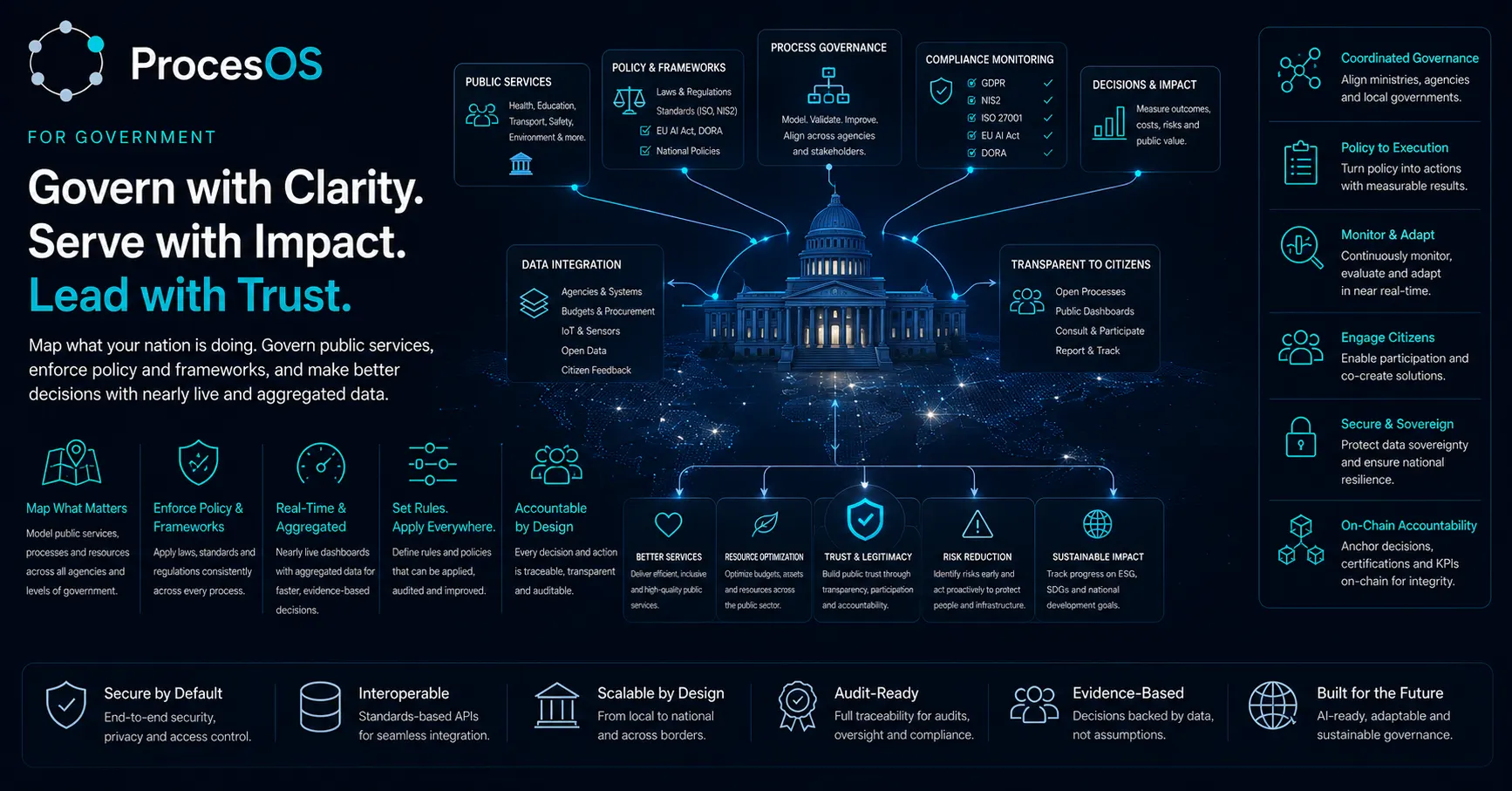
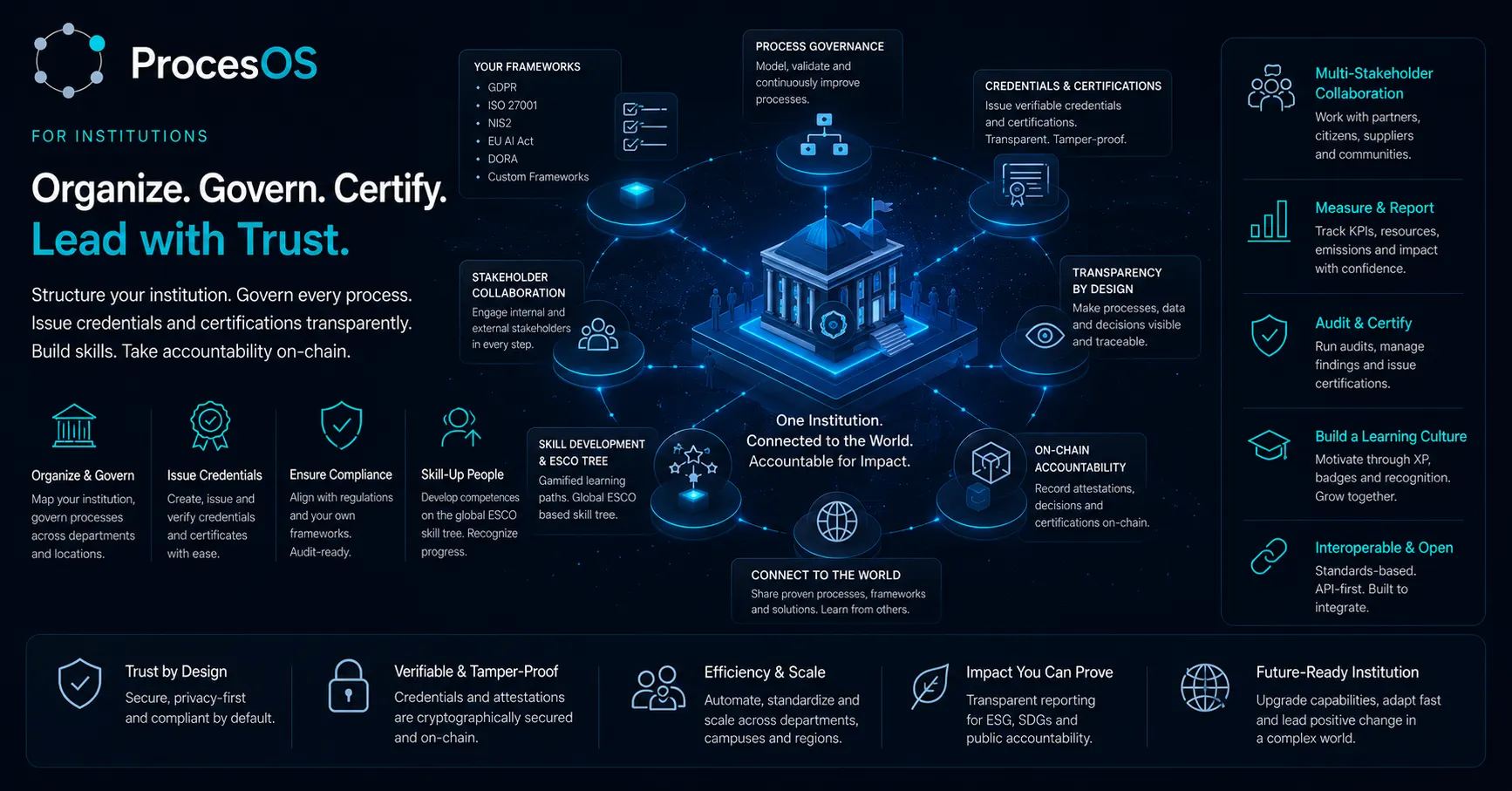
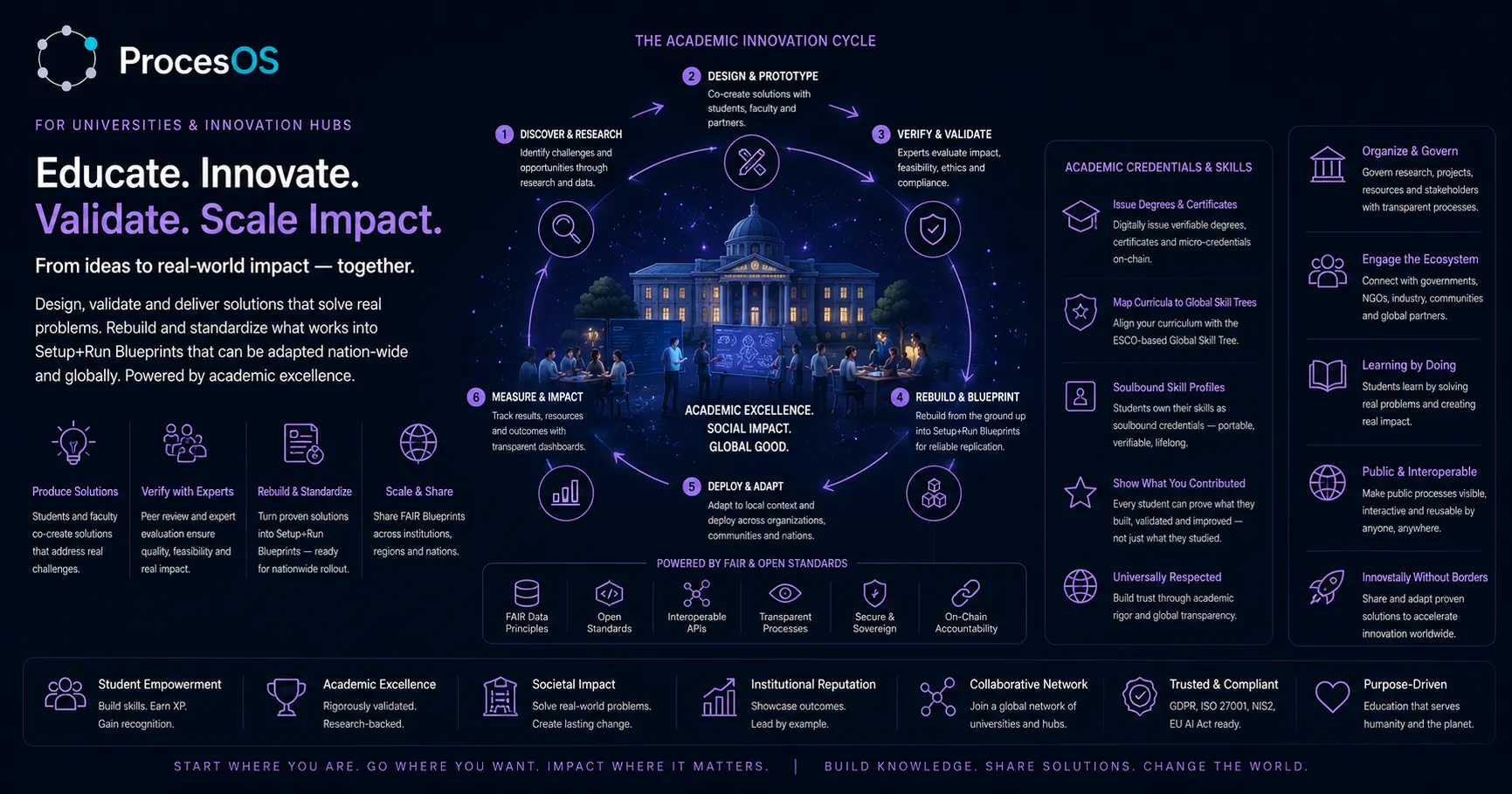
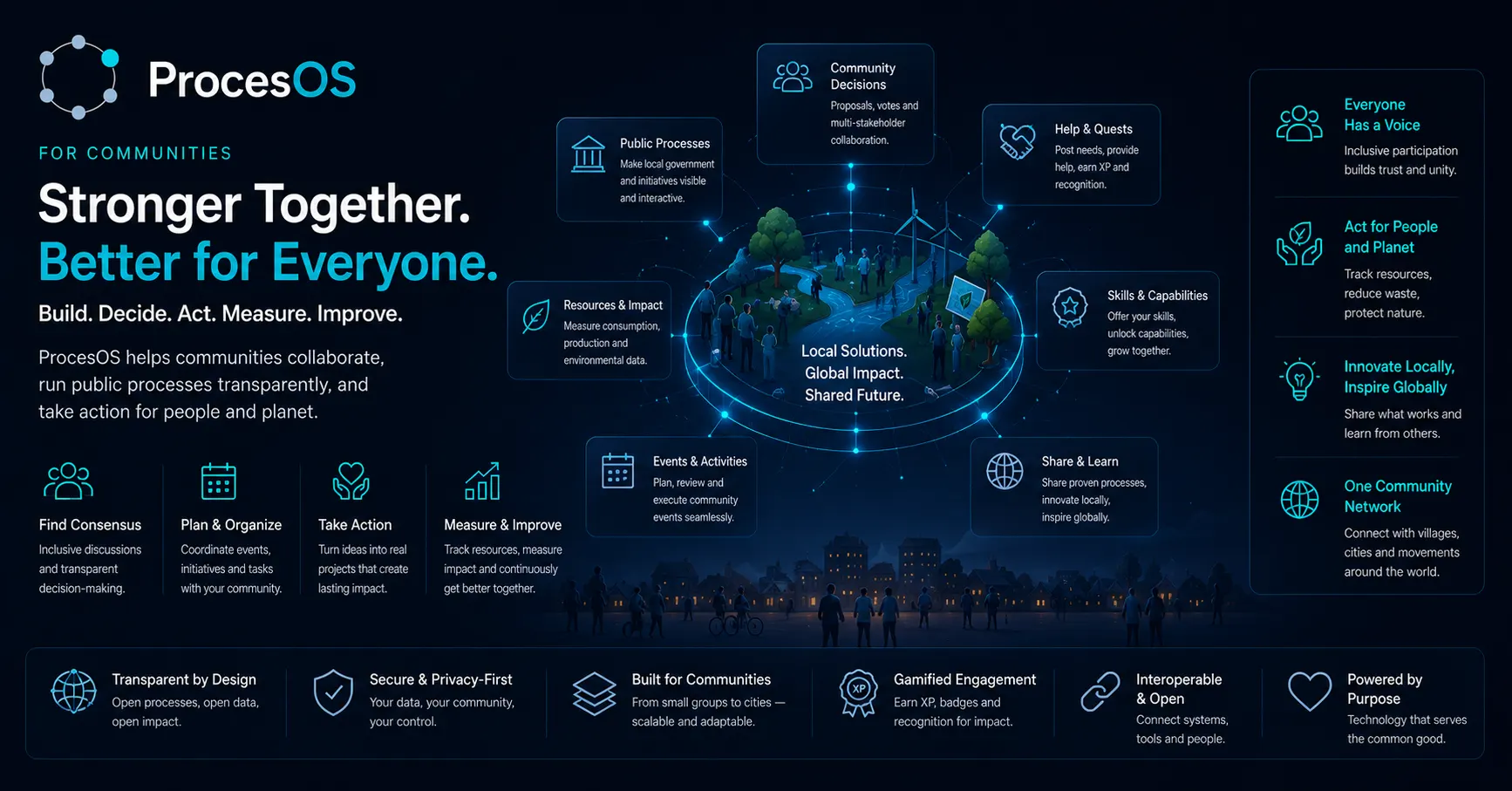
Inside ProcesOS
A look inside the platform.
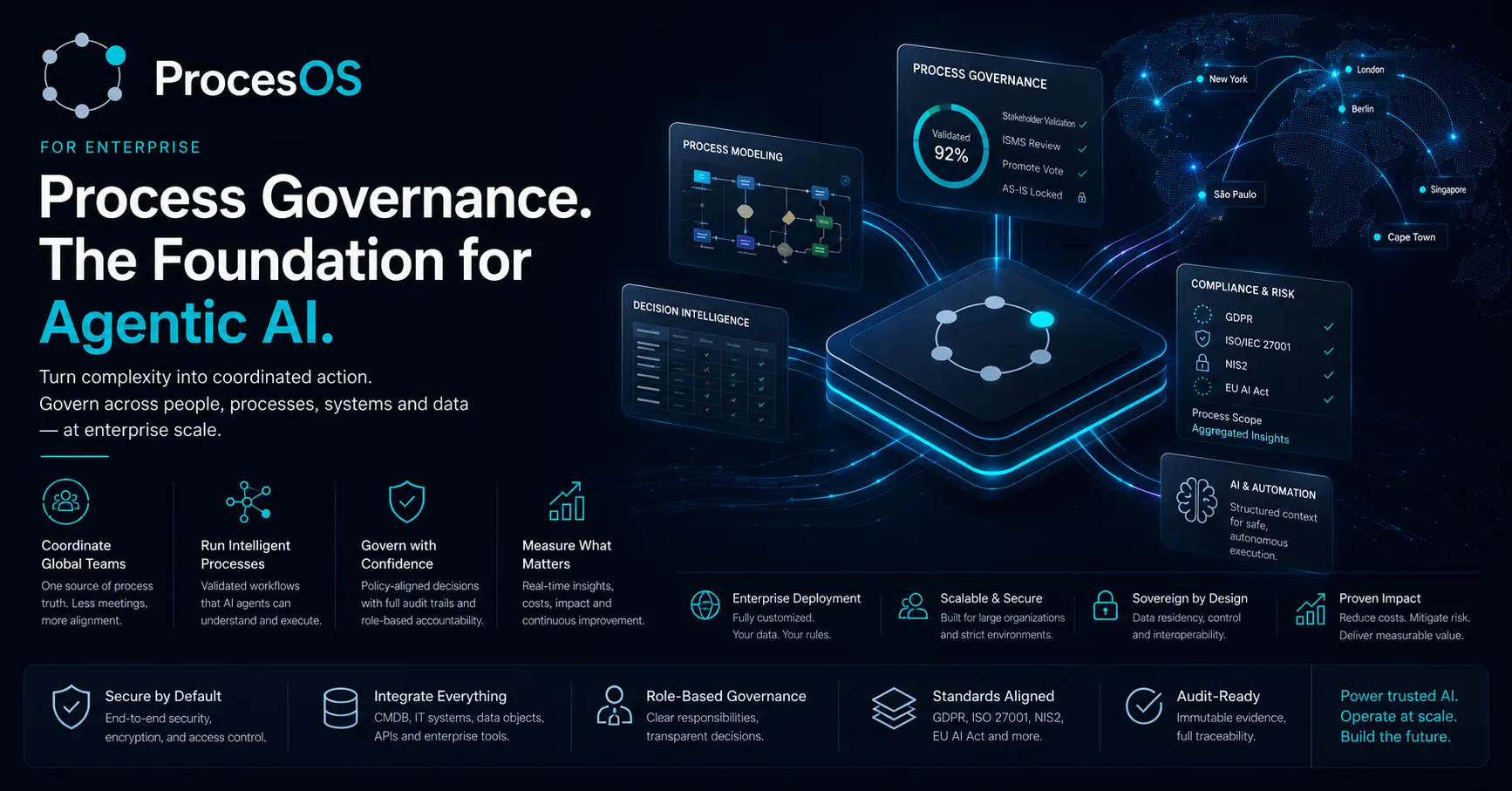
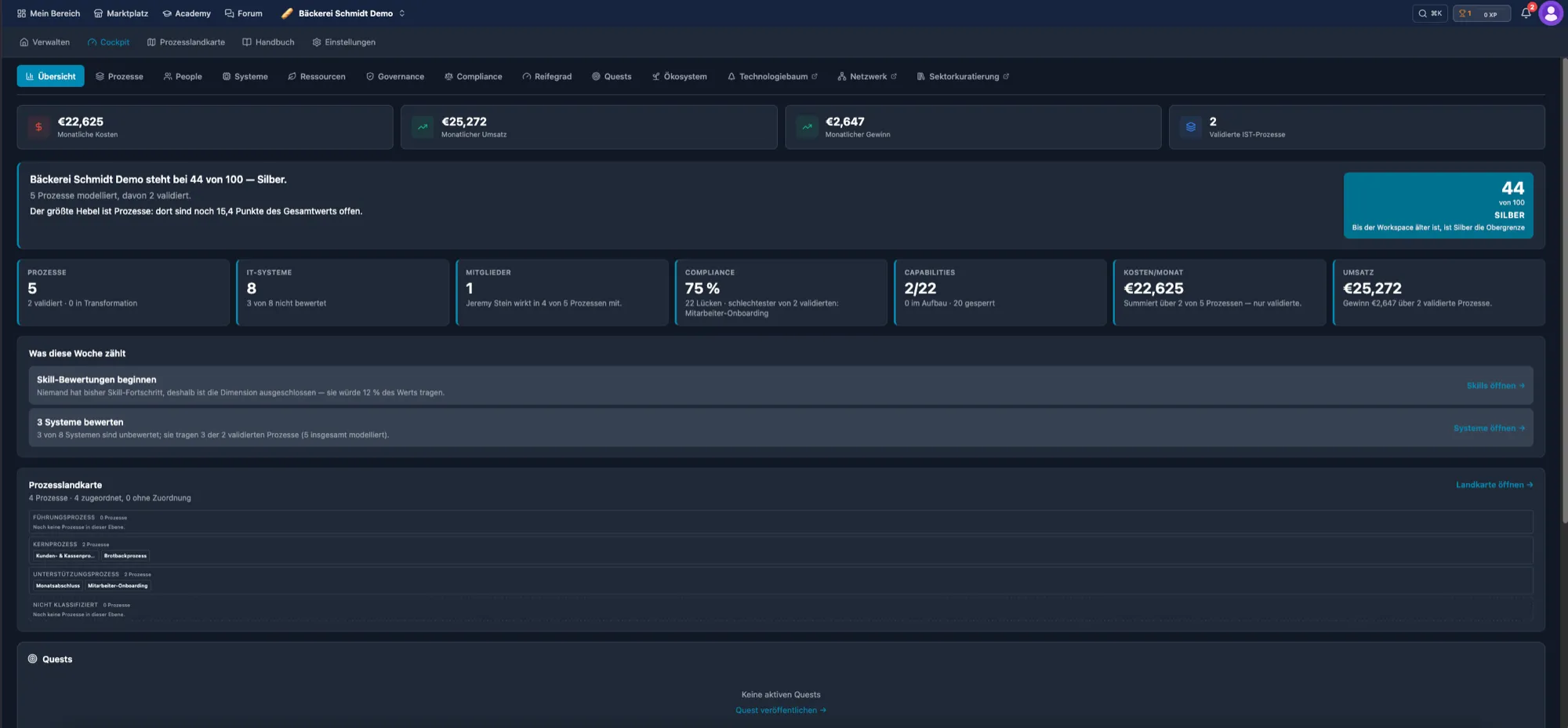
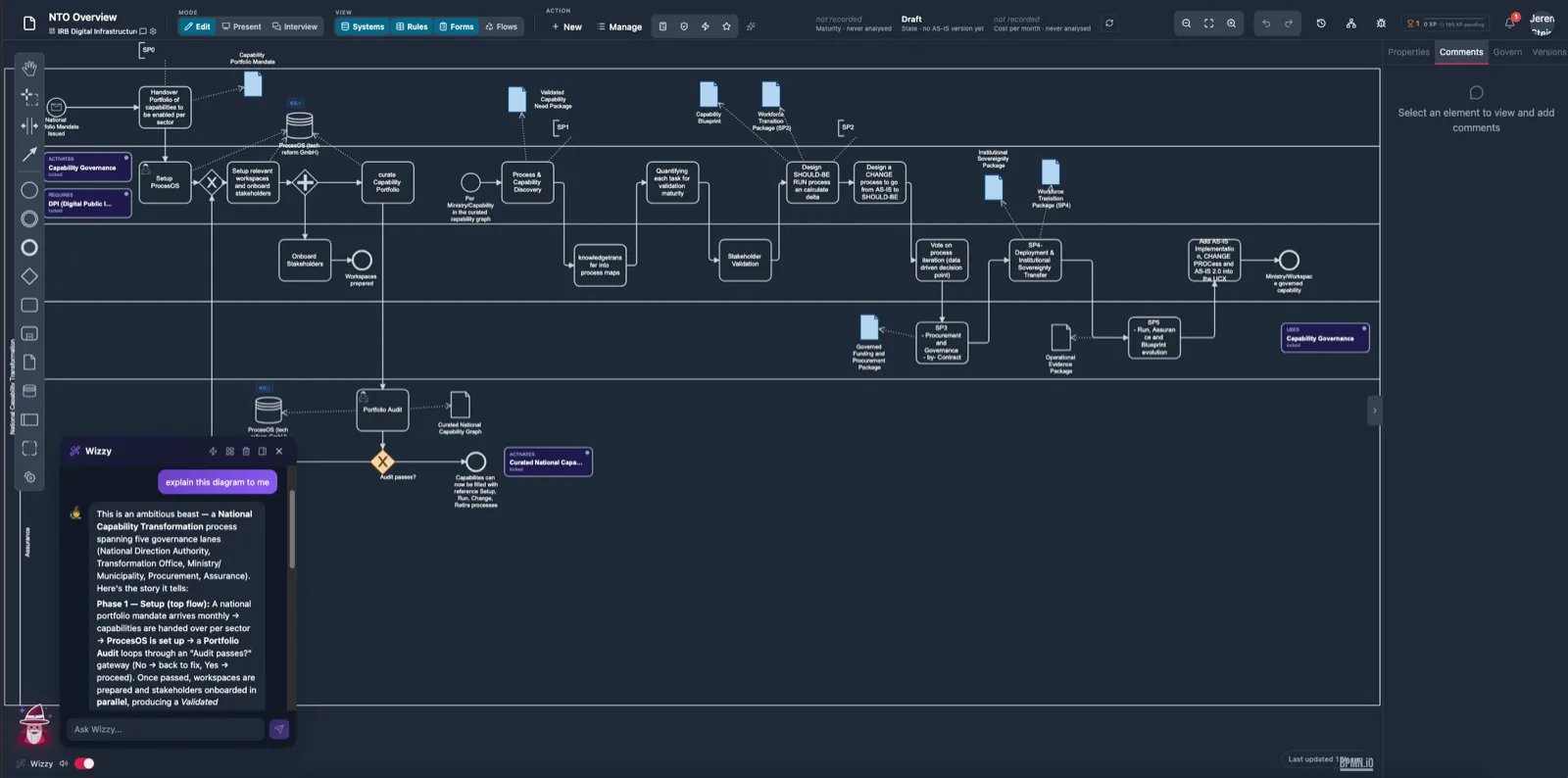
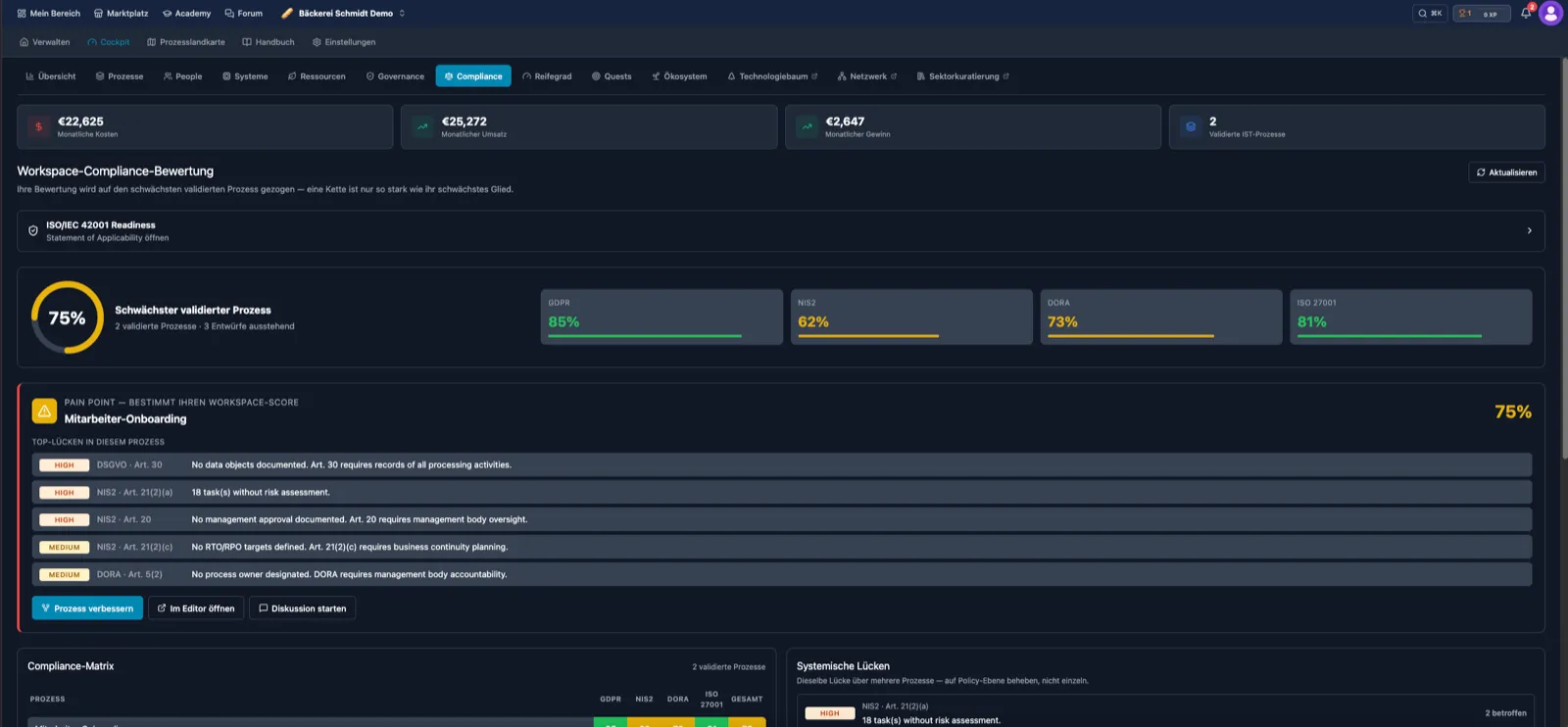
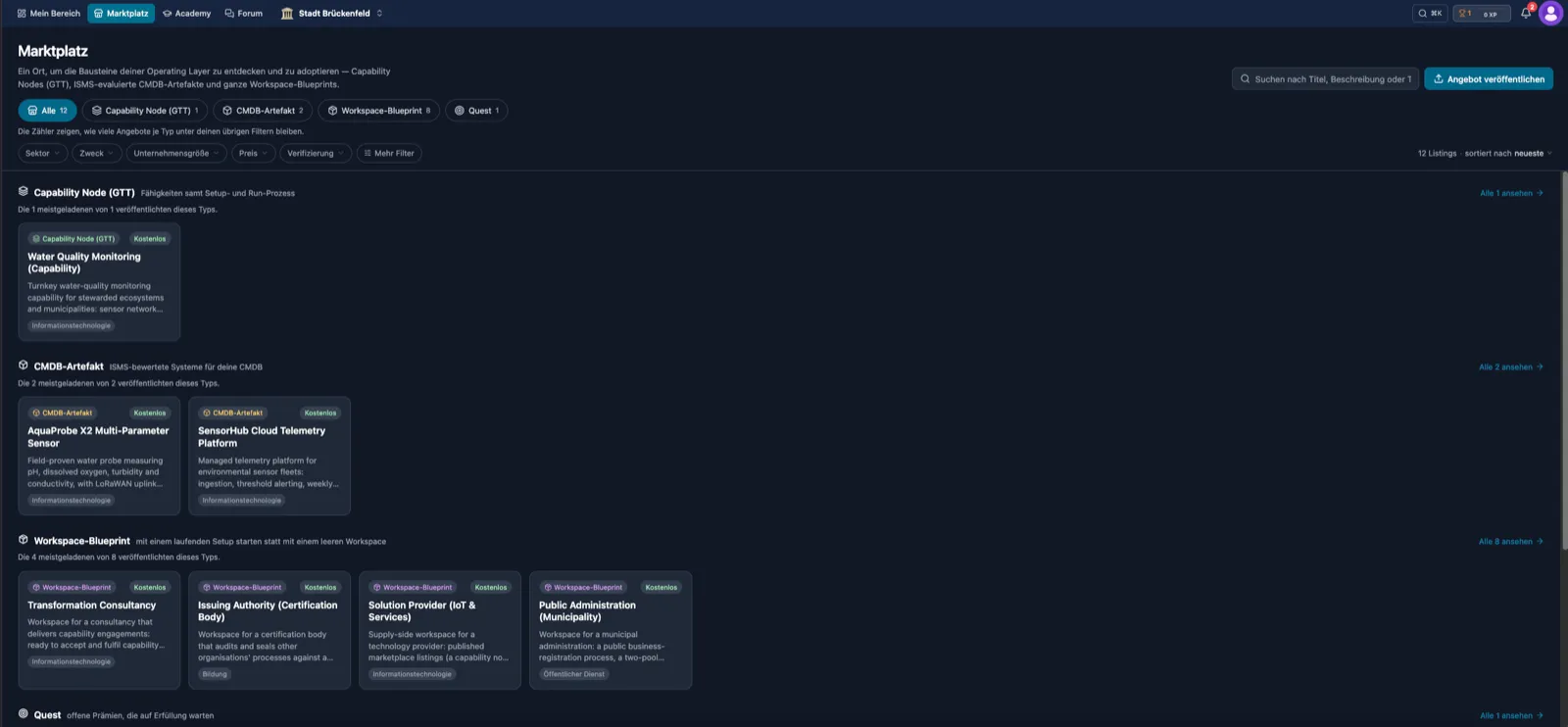
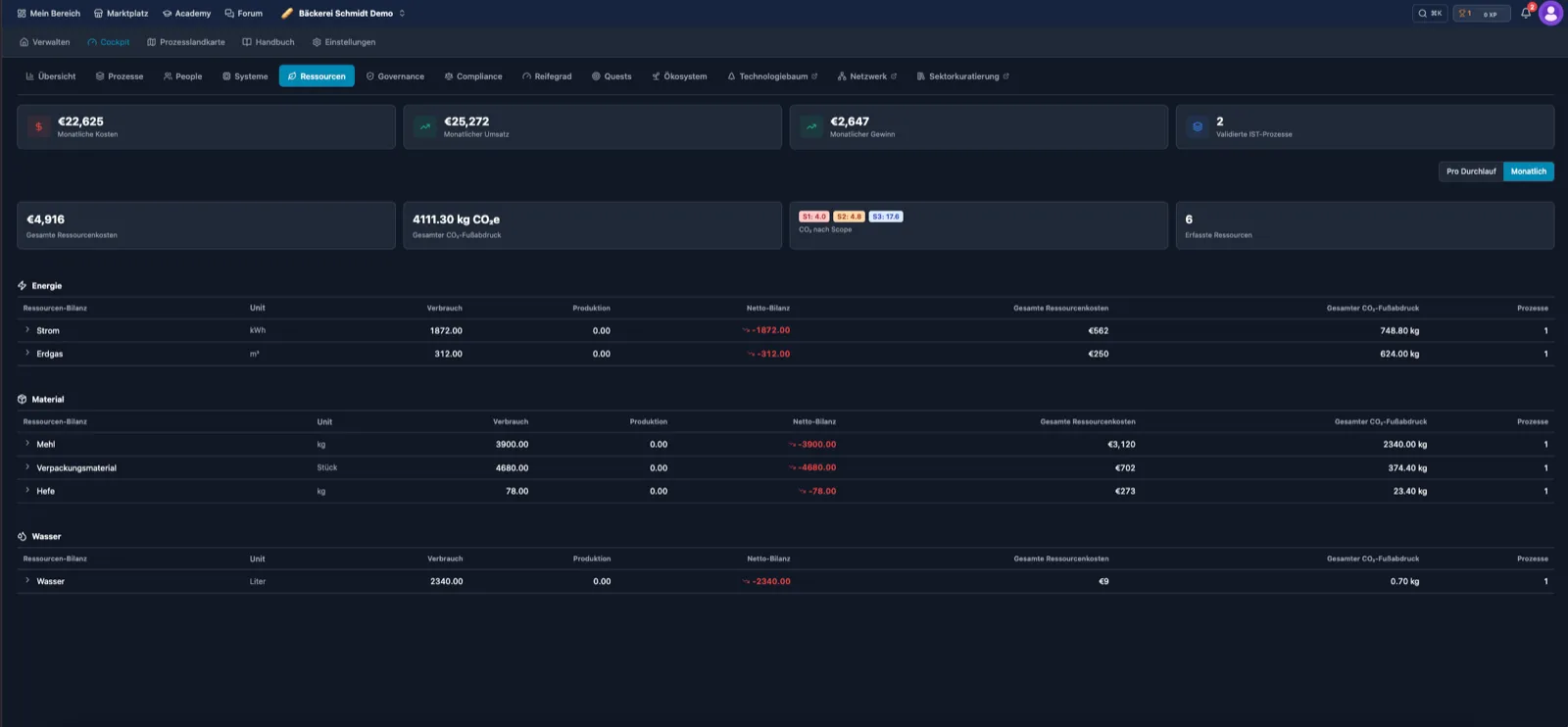
Five views from production deployments — the workspace cockpit, BPMN modelling with capability nodes, compliance scoring, the exchange, and the resource balance.
The CPG Cycle
Six pillars. One cybernetic loop.
ProcesOS implements the full CPG cycle — each pillar feeds the next, and Execute feeds back into Map.
- 01
Map
Capture the as-is reality in BPMN 2.0 — AI-assisted, with every role as a lane and every handoff explicit.
- 02
Quantify
Annotate cost, duration, and frequency per task and lane. Path analysis turns the model into a financial model.
- 03
Validate
Stakeholders review lane-by-lane. Every lane needs a Responsible owner before the process can advance.
- 04
Simulate
Fork the validated process into what-if scenarios. Compare AS-IS vs. SHOULD-BE with quantified deltas.
- 05
Decide
Responsible stakeholders vote on proposed changes. Every vote, comment, and decision is recorded immutably.
- 06
Execute
Lock accountability to deployment. Monitor against the validated model. Results feed back into Map.
Execute creates new reality, which must be mapped, quantified, and governed again — governance is a loop, not a line.
The capability layer
Processes are half the picture. Capabilities are the other half.
A process describes how work gets done. A capability describes what an organisation is actually able to do — and whether the foundations underneath it exist. ProcesOS governs both, and binds them to each other.
- 01
A forkable reference catalogue
The Universal Capability Exchange holds capability definitions that nations, sectors and institutions fork across five adaptation layers — without mutating the common node everyone else depends on.
- 02
A vocabulary that survives forking
What a capability is — its type — stays in a stable classification, held separate from the node that defines it. A national fork adapts the definition without breaking the shared vocabulary.
- 03
Six fields that must be human
Every definition carries six mandatory human fields — among them the judgement that must remain human, and the outcomes that are never acceptable. Carried as data, in any language.
- 04
Thirteen dimensions that never collapse
Capability assessments run across thirteen separate dimensions with supporting evidence. Eight red flags route a capability to review or refusal regardless of how strong the rest of the picture looks.
- 05
Bound to the processes that build them
A capability points at the diagrams that set it up and run it. Validating the setup process activates the capability — a claim with no process behind it is flagged, not assumed.
- 06
Know the gap before you procure
Pick a target capability and the missing prerequisites come back as an ordered route, with the cost basis on the node. Baseline first, procurement last.
FAIR Process Governance
If governance is defined as a process, it can be verified by design.
Every workflow is modelled in BPMN 2.0 — the open standard for process interoperability. Lanes carry hourly cost rates. Tasks carry duration and per-execution costs. Start events define frequency. End events define revenue.
Path analysis runs depth-first from every start to every end event, automatically computing cost per run, monthly cost, revenue, profit margin, and ROI. The BPMN diagram is the financial model.
Before validation, the system enforces pre-checks: every start event needs a frequency, every task needs a cost or duration, every lane needs an hourly rate, and every path must be reachable. Only then can stakeholders validate — one vote per user per task, no gaming.
AIFOD SC4 Sustainable Impact Scoring
Every published blueprint is auto-scored across six dimensions on a 0–5 scale, based on process data — not self-assessment.
- 01
Socio-Economic Impact
Jobs created, lane diversity, revenue, stakeholder satisfaction.
- 02
Environmental Sustainability
System carbon categories, open-source usage, data jurisdiction.
- 03
Community Engagement
Cross-org lane involvement, validation status, regional partnerships.
- 04
Transparency & Accountability
FAIR IRB scores, governance completeness, audit trail.
- 05
Scalability & Replicability
Blueprint pair exists, interoperability scores, multi-region deployments.
- 06
Financial Sustainability
Setup cost transparency, revenue model, profit margin, ROI.
Decide Pillar
Vote change into existence.
Process changes in ProcesOS don't happen by decree. Proposed changes are simulated as SHOULD-BE versions against the validated AS-IS baseline — with quantified cost deltas, time savings, and ROI visible to every stakeholder.
Only Responsible stakeholders can vote. Every vote, comment, and justification is recorded in an immutable decision trail. Quorum and approval thresholds are configurable per process. Until stakeholders collectively vote approval, the change exists only as a proposal.
50%
Default quorum threshold
60%
Default approval threshold
On-chain
Cardano DLT for tamper-proof votes (Enterprise)
Adoption
Start free. Scale sovereign.
From a single workspace to self-hosted enterprise with on-chain governance.
-
Starter
Free
- 1 workspace, 5 members
- 3 validated processes
- Basic editor & analytics
- AI assistant (15K tokens/week)
- Publish to Blueprint Registry
-
Professional
€49/mo
- Unlimited members & processes
- Full CPG governance cycle
- Change voting & simulation
- AI modules (500K tokens/mo)
- FAIR SC4 certification
-
Team & Scale
€149/mo
- Multi-workspace collaboration
- Bring Your Own Key (AI)
- White-label & API access
- Cross-workspace governance
- +€29/additional workspace
-
Enterprise
Custom
- Self-Sovereign Identity (DID)
- On-chain voting (Cardano)
- Self-hosted deployment
- EUDI-compatible credentials
- Full data sovereignty
Under the hood
BPMN + SSI + DLT
The modelling layer uses BPMN 2.0 — the ISO standard for process notation. Every diagram is interoperable with any compliant tool, no vendor lock-in.
The identity layer uses Self-Sovereign Identity (W3C Verifiable Credentials 2.0) with DIDs. Credentials are minted, not issued by a central authority. Enterprise tier supports EUDI-compatible wallets.
The trust layer uses Cardano as the DLT for on-chain voting and credential verification. Blockfrost for RPC, Andamio for credential management. Votes are tamper-proof and publicly verifiable.
-
Sovereign by design
Self-hosted or platform-managed under your data-residency rules. No vendor lock-in.
-
Plugs into what you have
Odoo ERP sync brings real costs, inventory, and KPIs into process analytics. Connectors for Microsoft 365, Docusign, ISMS platforms, and cloud APIs.
-
Audit-trail by default
Every decision, change, and exception is recorded. Audits become a data query, not a project.
-
AI-assisted mapping
Domain experts describe processes in natural language — AI co-creates the formal BPMN diagram.
Partnership
AIFOD & the Blueprint Registry
ProcesOS is built in partnership with AIFOD — the AI For Development network. The FAIR Process Governance framework, the SC4 scoring methodology, and the Blueprint Registry are joint work with AIFOD's Subcommittee 4.
The Blueprint Registry implements a three-stage verification pipeline: Community blueprints (published by anyone, auto-scored), University Verified (validated by AIFOD partner universities), and Nationally Certified (integrated into national digital infrastructure). Each stage increases trust while preserving the ability to fork and adapt.
From the Bangkok Summit (Feb 2026)
See ProcesOS against your real processes.
In a 30-minute demo we walk through how ProcesOS would consolidate one of your actual workflows — no slides, just the framework on your data shape.